 Sideways markets can create opportunities for structured trading strategies — prices bounce within a band, buy low, sell high, repeat. Yet most traders bleed capital through emotional execution: buying late, selling early, or missing fills entirely.
Grid bots solve that specific problem, and by 2026, they’ve matured from obscure scripts into accessible, AI-assisted tools configurable in minutes.
This guide covers how price-range automation works, which bot type fits which market condition, and how to sidestep mistakes that quietly drain accounts.
Using BYDFi’s Spot Grid tool as the main example, this guide explains how traders can define price ranges, test settings with demo funds, and manage automated orders from one trading environment.
A grid bot automates a “buy low, sell high” strategy within a predefined price range by dividing it into multiple grid levels — placing buy orders at lower grids and sell orders at upper grids automatically.
How Grid Bot Trading Actually Works
Picture a ladder across a price chart. You define the top rung (upper bound) and bottom rung (lower bound). The bot fills in evenly spaced rungs between them. Every time price drops to a lower rung, the bot buys; every bounce to a higher rung triggers a sell.
Each completed cycle aims to capture price movements within the defined range — repeated around the clock without manual input.
Grid bots are volatility-harvesting systems. They don’t predict direction — they profit from oscillation. Range-bound markets are where Spot Grid bots shine, capturing repeated price movements within a range.
The Core Parameters That Define a Grid
Every grid bot runs on: upper and lower price bounds, grid quantity (2–99 subdivisions), investment amount, and optional take profit/stop loss prices. Spot Grid bots operate on USDT spot pairs — no margin, no borrowing.
Grid density matters more than beginners realize. More grids mean smaller per-cycle profit but more frequent fills; fewer grids mean larger per-trade profit but fewer executions. Finding the right density for an asset’s typical volatility is where real strategy begins.
Why 2026 Is a Turning Point for Crypto Order Automation
AI-recommended parameters. Platforms now generate grid configurations from historical backtesting, so beginners don’t face a blank canvas. The caveat: this reflects past behavior, not future predictions — a starting point, not a guarantee.
Bot Marketplaces. BYDFi Bot Marketplace allows users to explore community-created strategies and review available strategy information.
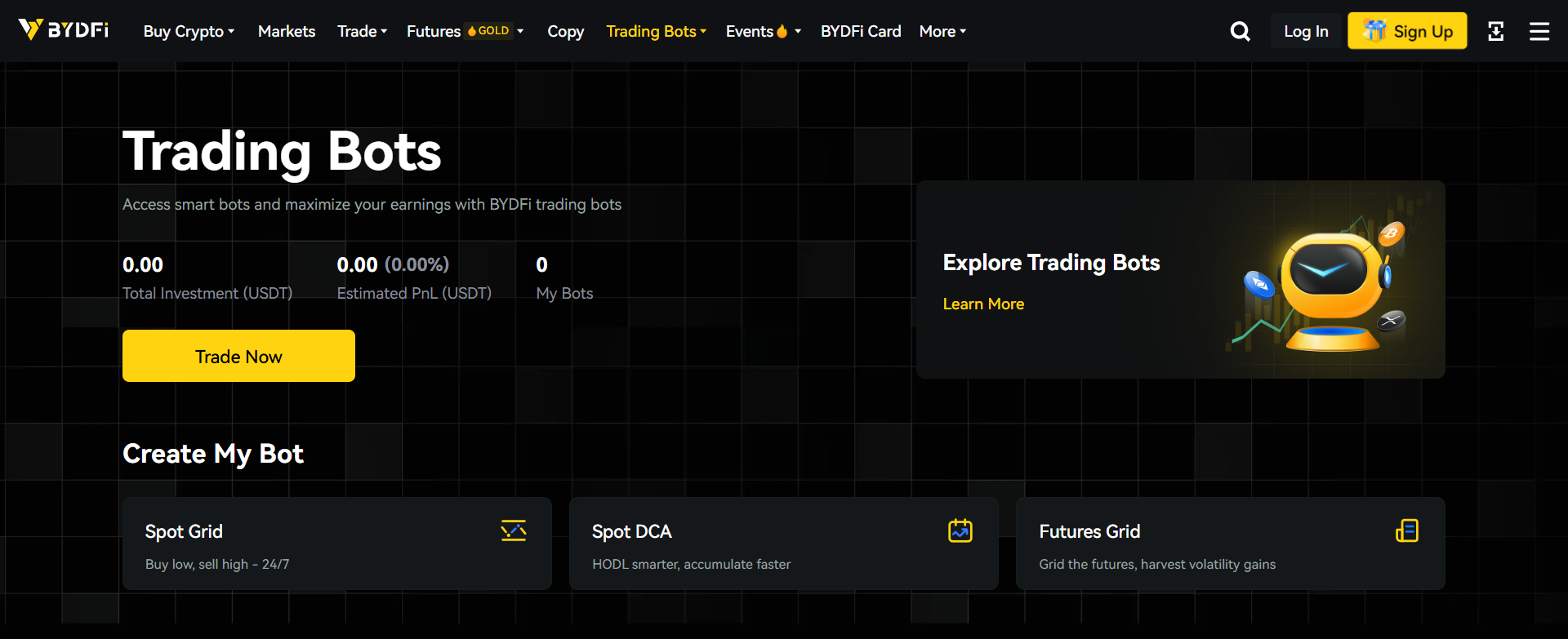 Multi-bot stacking. Traders can run up to 10 Spot Grid bots simultaneously on the same pair — a tight grid for frequent small captures alongside a wider grid covering the broader channel. BYDFi offers Spot Grid, Spot DCA, Futures Grid and Bot Marketplace features, giving traders a toolkit to combine approaches across shifting conditions.
How to Set Up a Spot Grid Bot: Step by Step
On BYDFi, setting up a Spot Grid bot follows a clear workflow. Traders choose a supported trading pair, define the price range, set grid quantity and investment amount, then decide whether to use AI-recommended parameters before launch:
- Select a USDT trading pair with range-bound behavior on your target timeframe.
- Define upper and lower price bounds — the expected oscillation range.
- Choose grid quantity (2–99) — more for choppy oscillation, fewer for wider swings.
- Set your investment amount — the bot distributes capital across levels automatically.
- Optionally set take profit and stop loss to automate exits if price breaks the range.
- Consider AI-recommended parameters generated from historical backtesting.
- Launch and let it run — operates 24/7; parameters modifiable anytime.
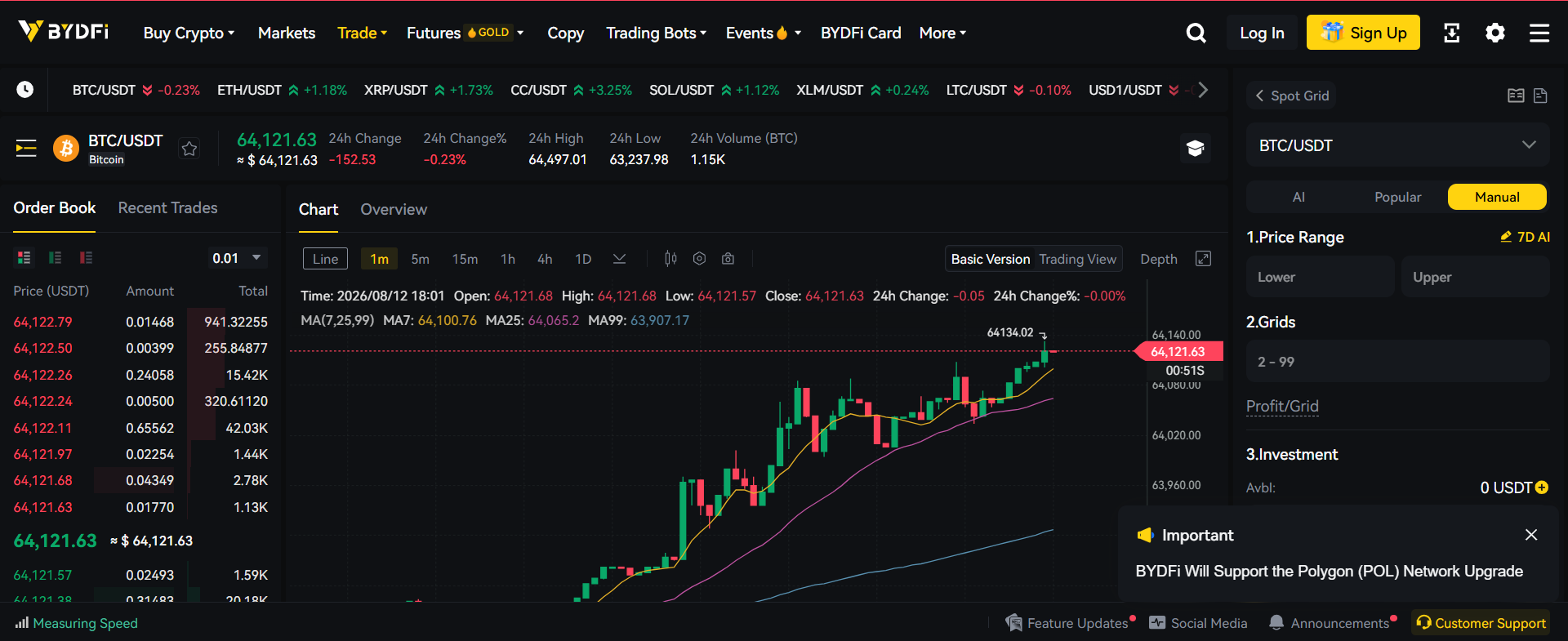 For a detailed walkthrough, the BYDFi grid bot strategy setup page is a helpful reference.
Spot trading fees sit at 0.1% buy / 0.1% sell. That 0.2% round-trip cost matters when calculating per-grid profitability, especially with tight spacing. Spot Grid bots aren’t subject to forced liquidation since they operate within spot balance — though held asset value can still decline significantly if prices fall below the grid range.
Which Bot Fits Which Market Condition?
| Market Condition | Commonly Used Bot Type | Why It Works | Key Risk |
| Sideways / Range-bound | Spot Grid | Captures repeated oscillations within range | Bot stops capturing upside if price breaks above upper bound |
| Sustained Uptrend | Futures Grid (long bias) | Captures volatility with directional exposure; leverage increases both potential returns and losses | Leveraged liquidation risk with standard TP/SL and Margin Ratio controls |
| Sustained Downtrend | Spot DCA | Buys fixed amounts at scheduled intervals (daily, weekly, monthly), lowering average cost | Continued decline erodes portfolio value |
Futures Grid extends grid logic to leveraged perpetual contracts. BYDFi’s perpetual contracts support multiple margin types (USDT-M, USDC-M, COIN-M) with adjustable leverage — though availability may vary by jurisdiction and eligibility. Futures Grid carries liquidation risk with the same controls as standard perpetual trading.
Spot DCA operates across supported spot trading pairs. Leverage amplifies both gains and losses — a principle applying directly to Futures Grid bots.
Common Mistakes to Avoid With Grid Bots
Setting the range too tight in a volatile market. If bounds don’t accommodate actual swing range, price breaks out and the bot sits idle — losing upside entirely above the upper bound.
Ignoring fee impact on narrow grids. With 0.2% round-trip fees, extremely tight spacing can mean each cycle’s profit barely covers costs. Calculate expected per-grid profit against fees before going live.
Skipping practice mode. BYDFi’s demo account comes preloaded with 50,000 USDT, giving users a practice environment to test grid settings and understand how parameters behave before using real funds.
Set-and-forget without monitoring. Test on a single pair first, check in weekly, and adjust as conditions evolve.
Pro Tips: How Experienced Traders Stack Grid Strategies
Running multiple bots across different ranges on the same pair captures both tight oscillations and wider swings. AI-recommended parameters serve as a baseline traders customize based on support and resistance levels.
Pairing a Spot Grid for range-bound conditions with Spot DCA for downtrend hedging covers multiple scenarios within one portfolio. Copy trading features let users follow and replicate other traders’ positions — separate from grid bots but complementary for diversified approaches.
BYDFi publishes Proof of Reserves reports, maintains reserves above 1:1, and operates an 800 BTC Protection Fund. In 2025, BYDFi entered a multi-year partnership with Newcastle United as the club’s Official Crypto Exchange Partner.
What to Expect Next
Bot Marketplaces will likely deepen social trading dynamics — expect granular performance metrics, strategy filtering, and community ratings. The convergence of AI-assisted parameters and shared strategies keeps lowering barriers, turning automated price-range trading into a standard tool.
New users can access onboarding incentives on BYDFi’s website. The demo account remains a practical way to test a first grid bot before committing capital.
FAQ
What is a grid bot and how does it automate crypto orders?
A grid bot automates a buy-low, sell-high strategy by dividing a user-defined price range into multiple levels, placing buy orders at lower grids and sell orders at upper grids automatically, operating automatically based on preset parameters.
How many grid levels can I set in a grid bot in 2026?
On the Spot Grid, traders can set between 2 and 99 subdivisions. More grids mean more frequent but smaller trades.
Do grid bots carry liquidation risk?
Spot Grid and Spot DCA bots operate within spot balance without forced liquidation — though held asset value can decline. Futures Grid bots use leverage and carry liquidation risk, with standard TP/SL controls available.
Can beginners use grid bots without designing parameters from scratch?
Yes. AI-recommended parameters can help users create an initial setup, and BYDFi Bot Marketplace gives users access to community-created strategy references. A demo account with 50,000 USDT is available for practice.
What happens if price moves outside my grid range?
If price breaks above the upper bound, the bot stops capturing upside and holds position. If price drops below the lower bound, the bot holds purchased assets at a loss until price re-enters the range or the user stops the bot manually.
Whether markets range, trend, or dip — the grid bot framework here gives traders a structured, automatable approach to price movement reducing the need for constant manual monitoring. Results will vary, and all trading carries risk of loss.