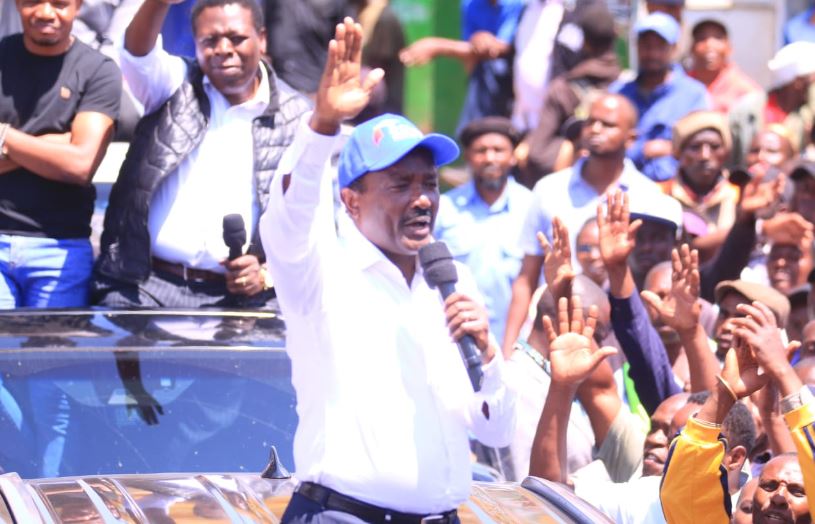
 Wiper Party leader Kalonzo Musyoka urged President William Ruto to stop attacking former President Uhuru Kenyatta and let him enjoy his retirement in peace.
Kalonzo stated that Kenya’s fourth president earned the respect that citizens give to former heads of state, adding that politicians should not drag Uhuru into political battles just because he associates with the Azimio la Umoja One Kenya Coalition.
While addressing congregants during a Sunday church service at Redeemed Gospel Church in Kithimani Township, Machakos County, on August 16, 2026, Kalonzo advised Uhuru to consider resigning from his position as Azimio chairman if rivals use that role as an excuse to target him.
“I have myself said, if Ruto is attacking Uhuru because he is chair of Azimio la Umoja One Kenya Coalition, I have advised him to leave that position so that you don’t throw mud unnecessarily at Uhuru Kenyatta,” Kalonzo said.
The Wiper leader still maintained that Uhuru remains a respected statesman who deserves dignity after leading the nation from 2013 to 2022.
“Uhuru Kenyatta is the fourth president of the Republic of Kenya. Na lazima apewe heshima (he must be shown respect),” he said.
Kalonzo spoke directly to Ruto, urging him to honor the long-standing tradition of respecting former presidents once they leave office. “And I now call Mr. Ruto to order. President Ruto, I call you to order,” he said.
He highlighted the transitions from Jomo Kenyatta to Daniel arap Moi and later from Moi to Mwai Kibaki as prime examples of peaceful power handovers and genuine respect for retired leaders. Having served as Kibaki’s vice president, Kalonzo remembered how Moi gracefully handed the instruments of power to Kibaki, even though Kibaki sat in a wheelchair during the ceremony.
He also brought up a past incident where certain Cabinet ministers tried to take away the house Moi occupied near Kibera shortly after he left office. Kalonzo explained that Kibaki firmly rejected this proposal and instead ordered officials to give Moi the title deed for that property.
“That is what Kibaki did, kuonyesha heshima kwa his predecessor, Daniel Arap Moi,” Kalonzo said. He further pointed out the strong bond between Kibaki and Uhuru, noting that Uhuru, who also served as a deputy under Kibaki, continued to honor his former boss long after Kibaki retired.
Kalonzo added that Uhuru showed deep respect for the constitutional transition when he formally handed power to Ruto after the 2022 presidential election. He vividly recounted the handover ceremony, noting how Uhuru presented Ruto with the critical instruments of power, including the Constitution and the ceremonial sword.
“Jameni Bwana Ruto, wacha mweshimiwa Uhuru Kenyatta enjoy his retirement bila kumletea aibu,” he said. The opposition leader argued that Kenyans need to preserve a political culture that treats former presidents with utmost dignity after their terms end. He cautioned that abandoning this noble tradition could seriously threaten the country’s political stability.
Kalonzo pointed to Zambia’s history after Kenneth Kaunda left office, noting that political feuds targeting former leaders sparked long-running national divisions.
“We don’t want Kenya to go that way,” he said. Kalonzo then shifted focus to President Ruto’s newly launched initiative to create a long-term national development plan that will replace Vision 2030.
The Wiper leader questioned why officials would pressure Uhuru to participate if the former president simply did not want the role.
“If he has refused to be chairman of Vision 2060, why force him?” he asked.
He argued that the government should leave Uhuru alone if he chooses not to participate in the new long-term development plan. Kalonzo defended the value of Vision 2030, a blueprint the Kibaki administration launched in 2008 with the goal of transforming Kenya into a newly industrializing, middle-income country offering a high quality of life by 2030.
Kalonzo advised that Ruto should therefore focus on solving the urgent problems facing Kenyans instead of dragging retired leaders into endless political disputes.