

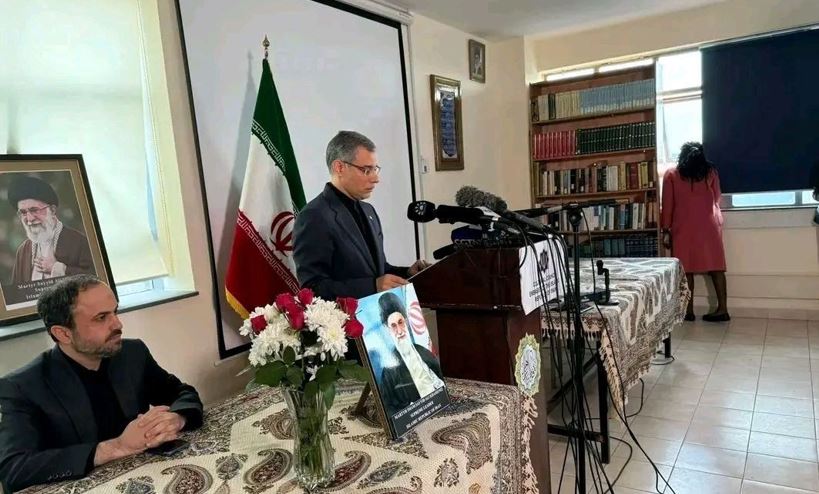
 As geopolitical tensions hit a breaking point in the Middle East, Iran has moved to calm fears that Kenya could be drawn into the crosshairs of its intensifying conflict with the United States and Israel.
Speaking at a press briefing in Nairobi on Monday, the Iranian Ambassador to Kenya, Dr. Ali Gholampour, assured the public that Iranian military capabilities do not pose a threat to Kenyan soil. He highlighted that Tehran has deliberately capped its missile range at 2,000 kilometers, a distance that falls well short of East Africa.
A Strategic Limit on Missile Range
Ambassador Gholampour framed the technical limitation as a deliberate choice to signal a defensive posture rather than a lack of capability. He described the restriction as “good news” for the region, suggesting it reflects Iran’s desire to avoid unnecessary escalation with distant nations.
“Our missiles will not reach the Kenyan territory. Our government has deliberately, in order to show its intention, a peaceful intention, limited the range of missiles only for defensive purposes,” he said.
This assurance comes during a volatile week. Iran recently launched a series of retaliatory strikes across the Middle East following high-profile attacks by the United States and Israel. Those strikes reportedly claimed the lives of Iran’s Supreme Leader, Ayatollah Ali Khamenei, and several high-ranking government officials.
Targets and Territory
The conflict has already spilled over borders, with Iranian missiles striking targets in the United Arab Emirates, Qatar, Saudi Arabia, Iraq, Oman, Kuwait, Jordan, and Bahrain. The violence escalated sharply following weekend operations by Washington and Tel Aviv.
As the confrontation widens, many have questioned the safety of countries hosting American military installations. Gholampour clarified that Iran views any foreign base used to launch an attack against its sovereignty as “American territory.”
However, he expressed firm confidence that Kenya would remain a neutral party. He noted that Kenya lacks the specific type of U.S. military infrastructure required to mount a direct assault on Iran.
“This country does not provide a US military facility with a magnitude to attack Iran,” Gholampour stated. “I do not believe that Kenya will provide such a facility to attack Iran from its land.”
The envoy pointed to the long-standing historical and diplomatic ties between the two nations as a cornerstone of their current relationship, noting that Iran intends to preserve these bonds.
Economic Ripples and Global Trade
While Kenya may be safe from physical strikes, the economic fallout of a prolonged war remains a serious concern. Gholampour acknowledged that full-scale conflict often disrupts vital trade routes and commercial corridors, which could trigger price hikes and supply chain issues in Africa.
A primary focus remains the Strait of Hormuz, one of the world’s most critical oil transit chokepoints. Gholampour confirmed that while Iran monitors and controls activity in the strait, it has no plans to block the flow of energy supplies or essential commodities bound for the African continent.
Despite the conciliatory tone toward Kenya, the ambassador’s message to the U.S. and Israel remained stern. He labeled the Saturday morning strikes on Iran as “cowardly” and “a fragrant violation of international peace and stability.”
He insisted that Iran maintains the right to defend itself as a sovereign state and warned of long-term repercussions for the recent assassinations.
“You have opened a door that you cannot close,” he warned, calling on the United Nations to intervene and halt the cycle of violence.
Safety of Kenyan Nationals
For Kenyans currently living in Iran, the ambassador offered a measure of relief. He reported that only a small number of Kenyan citizens reside in the country and confirmed that Iranian authorities are coordinating with the Ministry of Foreign Affairs to ensure their safety. He noted that officials are facilitating safe exit arrangements through designated corridors for any foreigners wishing to depart.