 President William Ruto has praised the newly unveiled framework for reparations for victims of human rights violations as a major step toward justice, reconciliation, and stronger democracy in Kenya.
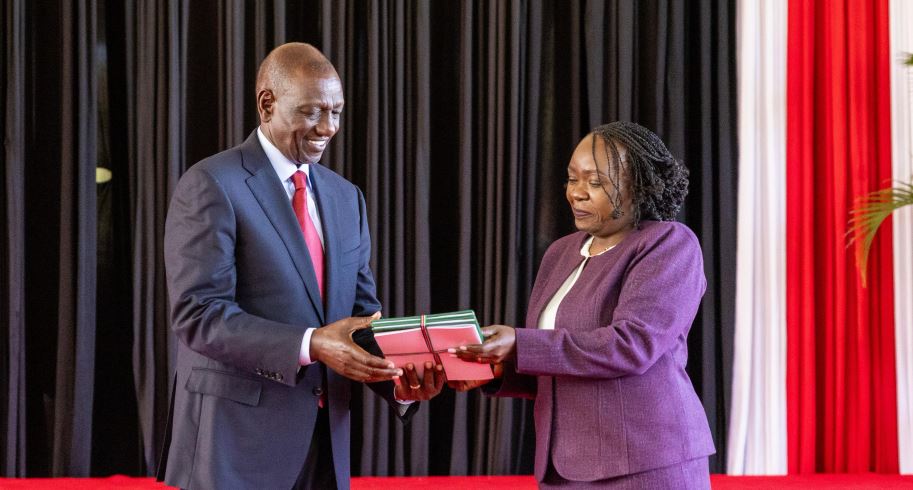
Speaking at State House in Nairobi while receiving a report from the Kenya National Commission on Human Rights on the Framework for Reparations for Victims of Human Rights Violations, Ruto said the initiative marks a historic milestone in addressing the suffering Kenyans endured during periods of unrest and political upheaval.
“This framework is a major milestone in protecting the rights of those harmed during protests, advancing social reconciliation, providing redress for victims, and strengthening democracy,” he said.
Ruto described the moment as both solemn and significant, saying it reflected the country’s commitment to confront injustices that had remained unresolved for years.
“This is a significant moment and a solemn one because we seek to make amends for harms that have never been repaid,” he added. “No compensation can restore a life lost, no reparation can fully erase the pain of a parent who lost a child, a spouse who lost a partner, or a family forever changed by tragedy.”
Ruto said Kenya is taking a decisive step toward healing by moving beyond expressions of sympathy and turning to practical action.
“Today we take an important step. We move beyond words. This marks the beginning of the end to a painful chapter,” he said.
He also stressed that the constitutional right to assemble, picket, demonstrate, and petition protects citizens and should not be treated as a privilege granted by the state.
“The right to assembly, picket, demonstrate, and petition is not a favor from the state. It is a constitutional guarantee and one of the freedoms that define Kenya as a democratic nation,” he said.
Ruto lamented the bitter aftermath of public demonstrations, noting that violence, tragic deaths, property destruction, and deep social fractures frequently mar these events.
“For far too long, whenever Kenyans exercise these rights, the outcome has been violence, loss of life, destruction of property, bitterness, and division. Families have buried loved ones, young people have carried physical and emotional scars, and communities have been left traumatized,” he said.
He pointed out how conflicting narratives inevitably surface after these clashes, as critics call out police brutality while others blame criminals who hijack peaceful gatherings.
“One side points to police brutality and another to criminal elements and goons, and then we move on only to repeat the cycle again,” he said.
To break this cycle and show a genuine commitment to justice and national healing, Ruto confirmed the Sh2 billion state fund to compensate victims harmed during the protests.
“As a demonstration of our commitment, we have allocated Sh2 billion towards compensation for those who have suffered from protests. This is the beginning of the journey and not the end,” he said.
The president quickly clarified that the administration does not view this financial aid as a price tag on human life or suffering.
“Let me be clear, the payments are not the price of life, pain, or loss because no amount of money can ever be,” he said. “What it represents is the state’s acknowledgement that harm occurred, that victims matter, and that a nation heals by tending to its wounds rather than pretending they do not exist.”
He firmly underscored that the reparations package does not endorse or reward lawlessness. “Nor is this redress a reward for violence or looting. It is a redress for harm suffered by citizens,” he said.