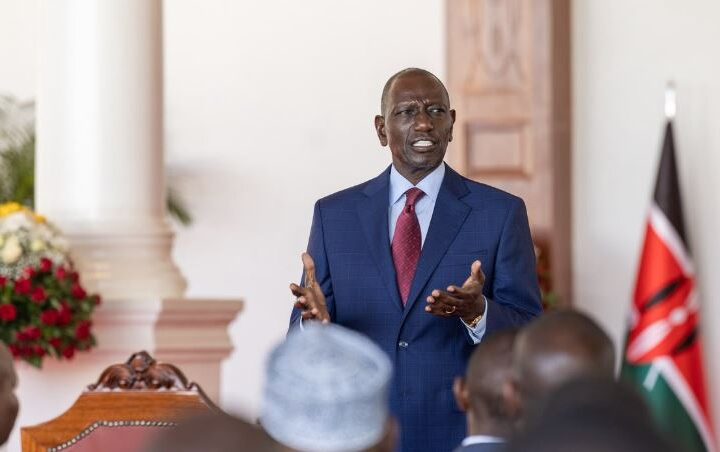

 President William Ruto has moved to overhaul Kenya’s traffic enforcement, directing authorities to fast-track the rollout of surveillance cameras and instant fines aimed at curbing a deadly surge in road accidents.
During a high-level meeting at State House, Nairobi, the president received a sobering report on road crashes from the National Council on the Administration of Justice (NCAJ). Confronted with data showing a sharp rise in fatalities, Ruto declared that the country must adopt urgent, tech-driven measures to protect lives and limbs on Kenyan highways.
Addressing the “Bribe vs. Fine” Dilemma
The president identified a broken enforcement system as a primary driver of lawlessness. He argued that the current judicial process is so cumbersome that it inadvertently fuels corruption, as motorists find it more convenient to bribe a police officer than to navigate the legal system.
“The reason why it is easy to pay a bribe rather than go to court is because it takes so long to pay a legitimate fine, so it encourages so many people to pay a bribe,” Ruto said. “We must make it much more painful to pay the bribe and much more easy to pay the legal fine.”
By introducing on-the-spot digital fines, the government aims to strip away the incentive for bribery, ensuring that traffic offenders face immediate and unavoidable consequences for reckless behavior.
A One-Month Deadline for CCTV Rollout
Technology sits at the heart of this new enforcement strategy. President Ruto questioned the delay in deploying surveillance infrastructure and issued a stern one-month ultimatum to Transport Cabinet Secretary Davis Chirchir to complete the national rollout of CCTV and speed cameras.
Ruto believes that removing the “human element” from detection will lead to higher conviction rates and more disciplined driving.
“Why haven’t we rolled out the cameras on our roads? It is just as simple as that,” he said. “The cameras will provide foolproof evidence about the offense. We have the law, we have the cameras. Let’s roll them out.”
The Human and Economic Cost
The statistics provided by the NCAJ paint a grim picture of Kenya’s road safety. The president noted that the country consistently records over 4,000 deaths annually. In 2025, the situation worsened, with 5,009 people losing their lives, an increase of 261 fatalities compared to 2024.
Beyond the immeasurable grief of families, Ruto highlighted the staggering impact on the national treasury.
“These accidents and their ensuing fatalities and injuries cost our economy the equivalent of 5% of our GDP, translating to an estimated loss of Ksh.450 billion annually,” he said.
To ensure these reforms take hold, Chief Justice Martha Koome proposed a coordinated adjudication framework. This system will link the Judiciary, the National Transport and Safety Authority (NTSA), the National Police Service (NPS), the Office of the Director of Public Prosecutions (ODPP), and the Kenya Prisons Service.
Ruto backed this “whole-of-government” approach, suggesting that certain traffic offenses be reclassified as administrative measures to streamline the legal process and reduce the backlog in traditional courts.
“We cannot, and we will not, accept the continued loss of Kenyan lives on our roads,” the President concluded. “The government is fully committed to ensuring that the recommendations arising from this pilot are implemented decisively and without undue delay.”