
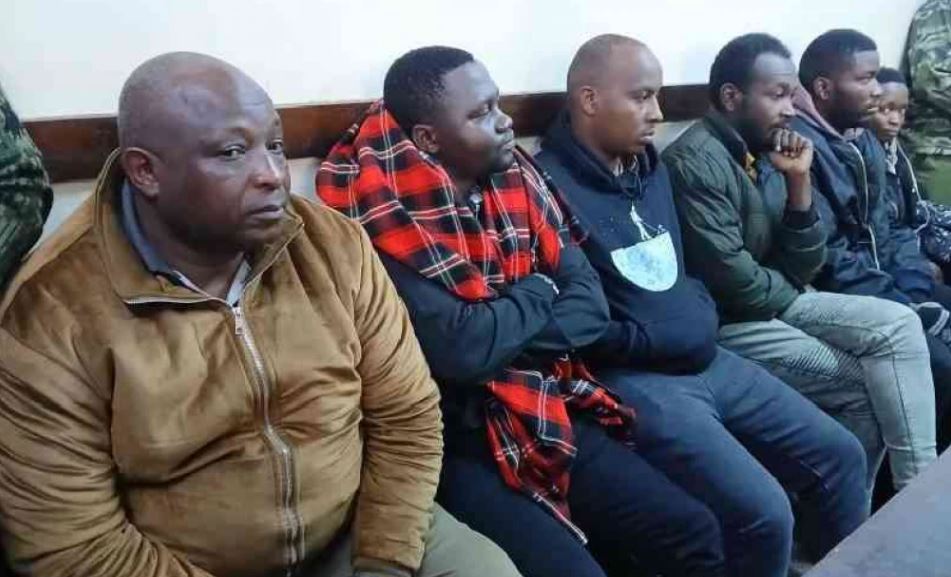
 Former Central Police Station OCS Samson Talaam and five others accused of murdering blogger Albert Ojwang will stay in custody after the Kibera High Court denied them bond.
The suspects – Talaam, Constable James Mukhwana, Peter Kimani, John Ngige Gitau, Jim Ambao, and Brian Njue – allegedly killed Ojwang on the night of June 7th and 8th, 2025, at Central Police Station in Nairobi.
Justice Diana Kavedza declined to grant them bail, ruling that they will remain in custody until key witnesses testify. She emphasized that the case carries great public interest, adding that Talaam, Mukhwana, and Kimani “are police officers who still wield a lot of power given their training and may interfere with witnesses.”
The court ruled that there were genuine fears of interference with crucial witnesses, especially those serving within the police force. Justice Diana Kavedza noted that CCTV footage at Central Police Station had been tampered with before the accused were arrested. She further observed that although the first and second accused claimed they had been interdicted, they still retained connections and influence strong enough to undermine the criminal justice process.
The judge added that Ojwang’s killing sparked nationwide protests, which left behind extensive property damage, including the burning of Mawengo Police Station. While acknowledging that bail is a constitutional right under Article 49, the court stressed that it is not absolute.
“The gravity of the offence of murder coupled with the high profiles of the accused increase the likelihood of absconding trial,” the court stated.
Although the defence argued that there was no evidence of witness interference or tampering, Justice Kavedza held that the balance of public interest and national security outweighed the accused persons’ right to liberty at this stage. She also observed that Ojwang’s relatives had expressed fear for their lives.
“The application of bail is declined at this stage until the witnesses at the Central Police Station have testified,” the court ruled.
However, Justice Kavedza granted the accused the option of seeking a review of their bail application once key witnesses had taken the stand.