
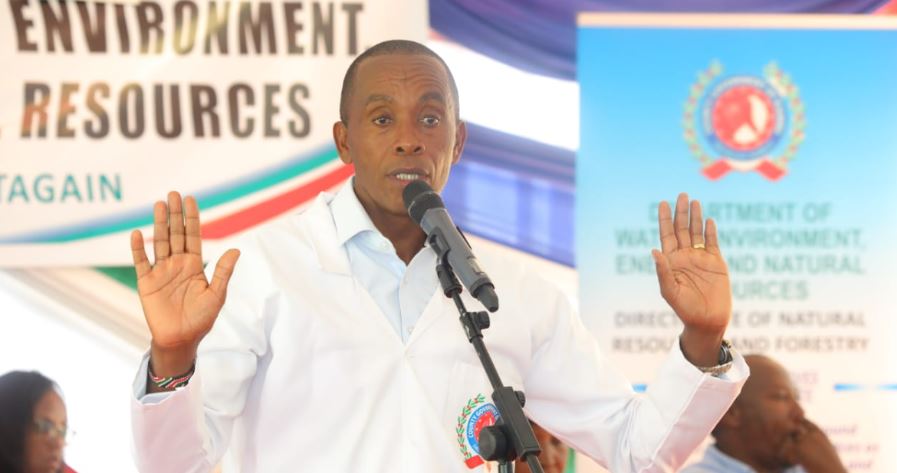
Kiambu Governor Kimani Wamatangi has received temporary relief from the High Court, which has blocked his arrest and prosecution.
Justice Chacha Mwita issued the conservatory orders on Thursday after the governor’s legal team filed an urgent application for protection against possible legal action.
In his ruling, Justice Mwita directed the Director of Public Prosecutions (ODPP) and the Ethics and Anti-Corruption Commission (EACC) to hold off arresting or charging Governor Wamatangi until the court hears and decides on the case.
Justice Chacha Mwita acknowledged that while parts of the investigation into Governor Wamatangi had been conducted under valid warrants of the courts, the Director of Public Prosecutions (ODPP) remained yet undecided on whether to prosecute or not.
He clarified that the courts would not intervene and interrupt the work of the investigating agencies unless there was apparent evidence that they had violated their constitutional mandate.
The judge also warned authorities not to trample on the constitutional rights of Governor Wamatangi during the probe. Specifically, he emphasized the preservation of the governor’s right to privacy and dignity as a human being.
In court, lawyer Arwa, who was defending Wamatangi, argued that his client was unjustifiably targeted and risked unlawful arrest and harassment, which would constitute a violation of his constitutional guarantees.
On the other hand, the EACC, through advocate Ruto Murugi, objected to the court ordering conservatory orders.. Murugi argued that the agency was simply carrying out lawful investigations and denied any claims of harassment or intimidation against Governor Wamatangi.
Justice Mwita directed the ODPP to file its response to both the application and the main petition within 14 days. He further instructed that the governor’s legal team would have an equal amount of time to file any supplementary affidavits and written submissions, each limited to 10 pages. The respondents will then have another 14 days to submit their responses.
“The petitioner will then have an equivalent period to file any supplementary affidavits and written submissions, each limited to 10 pages. The respondents will also be expected to file their written submissions within 14 days thereafter,” Justice Mwita stated.
The case is scheduled for mention on September 19, 2025, when the court will issue further directions.