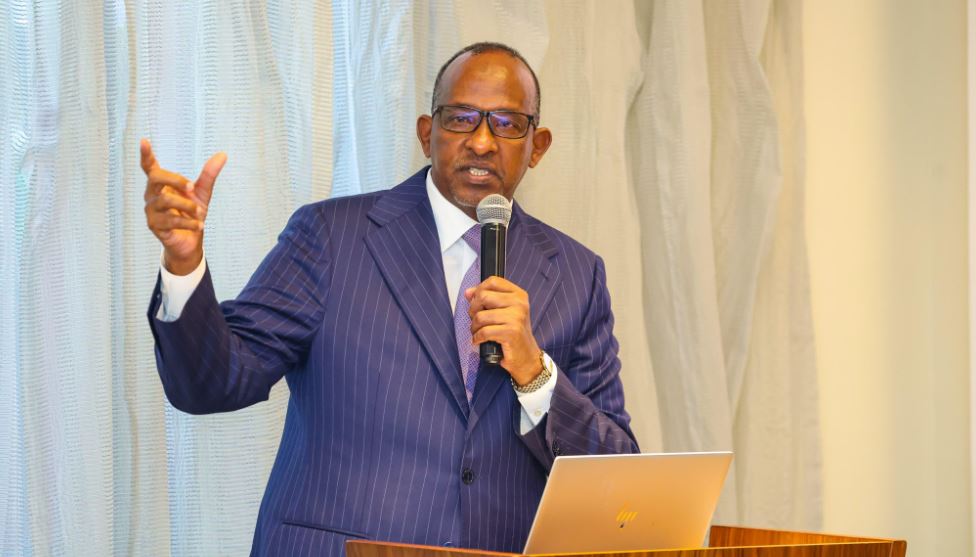
 Health Cabinet Secretary Aden Duale has addressed the controversy surrounding the service fee charged on claims processed through the national digital health system, dismissing media reports claiming that public funds are being diverted to a private entity.
Responding on Tuesday, August 4, to a local newspaper report, Duale rejected the article’s narrative, clarifying that it created a misleading impression about the legal framework governing the fee. He pointed out that the government has undertaken an unprecedented reform by placing the country’s entire health financing system on a single, verifiable digital platform.
“This administration has undertaken what no government before it attempted: to place the entire health financing system of this country on a single, verifiable digital platform. Such a system must be built, secured, run, and maintained, and the law provides for how it is paid for,” the statement read.
Duale explained that the 2 percent charge is legally anchored under Regulation 11(2) of the Digital Health (Data Exchange Component) Regulations, 2025. The regulation requires users of the Health Information Management Service (HIMS) to pay a service fee, while the Third Schedule caps the fee at Ksh5,000 regardless of the total value of the claim.
“It is therefore a capped fee for the use of a system. It is not an open-ended share of any hospital’s earnings,” the statement added.
The Health CS clarified that users pay the fee directly to the Digital Health Agency (DHA), a state body established under the Digital Health Act, 2023. The law explicitly mandates the agency to operate the Comprehensive Integrated Health Information System and authorizes it to collect levy fees for its services.
“This is a charge by a public body, for a public system, authorized by statute,” the statement further read.
Duale also refuted suggestions that private entities control or receive healthcare funds meant for hospitals. He emphasized that only the Social Health Authority (SHA) holds the legal mandate to review, process, and disburse claim payments to contracted healthcare providers. Furthermore, he stressed that all money received by the DHA constitutes public revenue subject to statutory oversight and auditing.
“There is no parallel account and no hidden ledger. There is the ordinary constitutional process of public audit, and it applies here exactly as it applies to every other state agency,” the statement explained.
Addressing concerns regarding private sector involvement in building the digital health infrastructure, Duale noted that the government awarded the project contract to the Safaricom Consortium in accordance with public procurement laws. He added that lawful subcontracting within such agreements does not transfer control over public funds or claims processing to private companies.
The CS further noted that the Digital Health Regulations underwent a thorough regulatory impact assessment, extensive public participation, and stakeholder consultations before receiving approval from both Houses of Parliament and being gazetted on April 11, 2025.
“They have been freely available to every Kenyan since that date. A fee set out in a published law, debated and approved by Parliament, is not a mystery,” the statement noted.
Confirming that the matter is currently pending before the High Court where he is named as a respondent, Duale stated that the government will present its case formally in court rather than engaging in public debates.
“The matter is now before the High Court, and I am named as a respondent. The Government will file its full response on the record, and I will abide by the determination of the court. I will not litigate this matter in the press,” the statement read.
Duale concluded by assuring healthcare providers that the ministry remains open to dialogue, noting that he has instructed both the SHA and the DHA to resolve hospital complaints efficiently.
“To our healthcare providers: my door is not closed. I have directed the Social Health Authority and the Digital Health Agency to continue engaging you directly through the stakeholder mechanism and to resolve claims and complaints without delay. Where the system can be improved, we will improve it,” the statement concluded.