
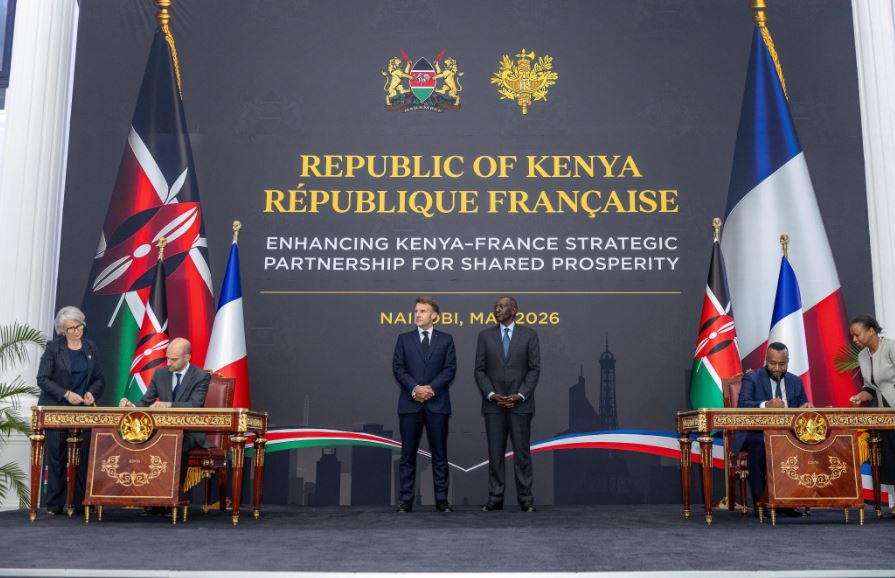
 Kenya and France have taken their bilateral relationship to a new level, sealing 11 wide-ranging agreements that span transport, energy, digital infrastructure, trade, and health, in what both governments are calling a transformative moment for the partnership between Nairobi and Paris.
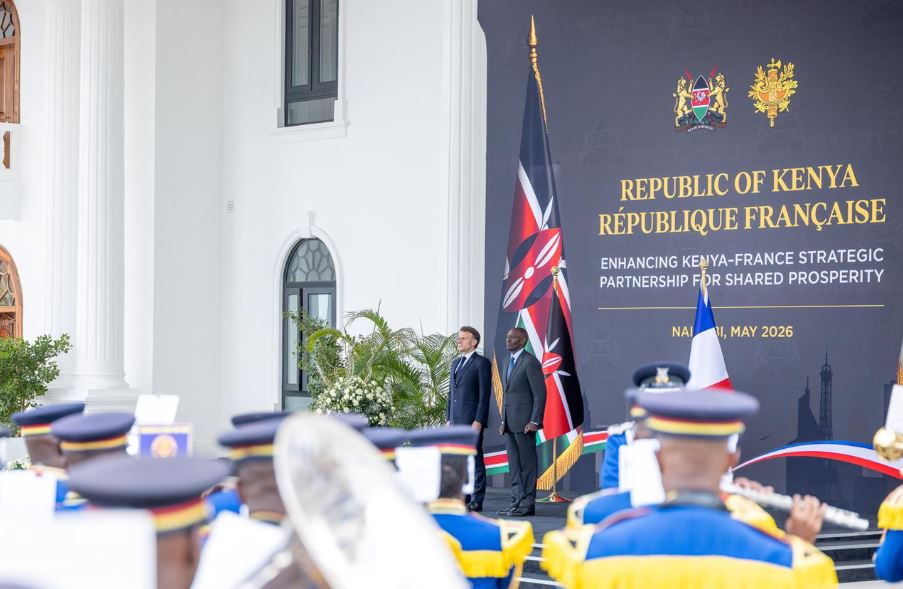
Presidents William Ruto and Emmanuel Macron signed the deals at State House, Nairobi, following high-level bilateral talks held alongside the Africa Forward Summit – a historic gathering that marks the first time in over fifty years the summit has taken place outside France or a Francophone African nation.
President Ruto called the choice of venue a powerful statement, noting that “Kenya is deeply honoured to host this summit.”
A Ksh12.5 Billion Bet on Nairobi’s Commuter Rail
At the heart of the agreements sits a Ksh12.5 billion commitment to rehabilitate and modernize the Nairobi Commuter Rail network. President Ruto identified the initiative as a central pillar of Kenya’s urban transport modernization program, with Line 5 serving as the primary focus.
The project will expand and upgrade key corridors linking Nairobi to satellite towns, including Syokimau, Embakasi, Ruiru, and Kikuyu.
Ruto also mentioned ongoing work beyond the existing network, noting that “new extensions, including the Riruta-Ngong line currently under construction, will further improve connectivity across the metropolitan area.”
For the tens of thousands of commuters who rely on these routes daily, the upgrades promise shorter travel times and a more reliable ride.
Ports, Logistics, and a Ksh104 Billion Trade Push
The two nations also agreed to jointly develop and finance logistics and port infrastructure in a deal worth approximately Ksh104 billion. The investment targets Kenya’s trade capacity at a time when the country is actively positioning itself as East Africa’s premier logistics hub, a goal that hinges on world-class port and supply chain infrastructure.
On the agricultural front, Kenya and France signed an agreement to bring premium Kenyan purple tea and other specialty varieties onto French retail shelves. The deal opens a direct pipeline to high-end European markets, creating opportunities for value addition and ensuring local farmers capture higher returns on their produce.
Nuclear Energy, Digital Growth, and Cybersecurity
In one of the more forward-looking announcements of the day, President Ruto revealed that Kenya intends to tap French technological expertise to develop safe nuclear energy. The partnership supports Kenya’s ambitious target of generating 10,000 megawatts of power to fuel industrial growth.
“Kenya is going to benefit from France’s understanding of nuclear energy,” Ruto said, signaling a long-term shift toward a more diversified national energy mix.
On the digital front, the two leaders explored deeper collaboration in cybersecurity, digital public services, and artificial intelligence – sectors the Kenyan government sees as foundational to its broader technology ambitions.
Ruto pointed to flagship projects like Konza Technopolis and the Digital Superhighway as proof points of the country’s commitment to building a dynamic digital economy, with the goal of cementing Kenya’s position as the leading technology and innovation hub for East and Central Africa.
Wind Energy, Aviation, and the Blue Economy
The agreements extended into several other sectors. Kenya and France committed to a Ksh32.5 billion expansion of the Kipeto Wind Energy Development Project, which will add 100 megawatts to the national grid. They also agreed to produce Sustainable Aviation Fuel within Kenya and to transform agri-food systems, alongside deals covering the blue economy, fisheries, and funding to raise the Masinga Dam.
President Ruto also pushed for stronger air connectivity between Kenya and France, arguing that current restrictions are holding back trade, tourism, and business.
“At present, limitations in frequency, capacity, and routing constrain the full potential of direct air links between our two countries,” he said, making clear that removing those bottlenecks ranks among his priorities for the relationship.
Health, Education, and Climate Finance
The two countries pledged to deepen cooperation in digital health, laboratory systems, and epidemic preparedness, with a focus on using real-time data for early detection of and rapid response to health threats. “This will enhance healthcare delivery and strengthen Kenya’s capacity to respond to future outbreaks,” Ruto said.
Education featured prominently as well. The Ksh5.6 billion University of Nairobi Engineering and Science Complex, a state-of-the-art facility designed to build high-level STEM and technical vocational expertise, moves into its implementation phase as part of the partnership.
Both leaders also reaffirmed their commitment to reforming the global financial architecture, advocating for changes that guarantee developing nations fair and predictable access to financing.
“President Macron and I agreed that the Africa-France Summit must move beyond dialogue to implementation,” Ruto said.
Macron’s Commitments and Kenya’s Independent Path
President Macron, for his part, pledged to expand French investment across Africa and to champion reforms of the international financial architecture at the upcoming G7 Summit.
“We will try and speed up the reform of the African Financial Infrastructure with the African Development Bank,” he said. He also clarified that hosting the summit in Nairobi carries no signal of exclusion toward West Africa, confirming the region’s representation at the meeting.
Ruto closed the day’s diplomacy with a pointed statement about Kenya’s geopolitical identity. In a world increasingly defined by great-power competition, he made clear that Kenya is not choosing sides. “We are looking forward,” he said – a concise expression of a strategy built on pursuing partnerships with any nation aligned with Kenya’s specific development goals, regardless of traditional geopolitical divides.