

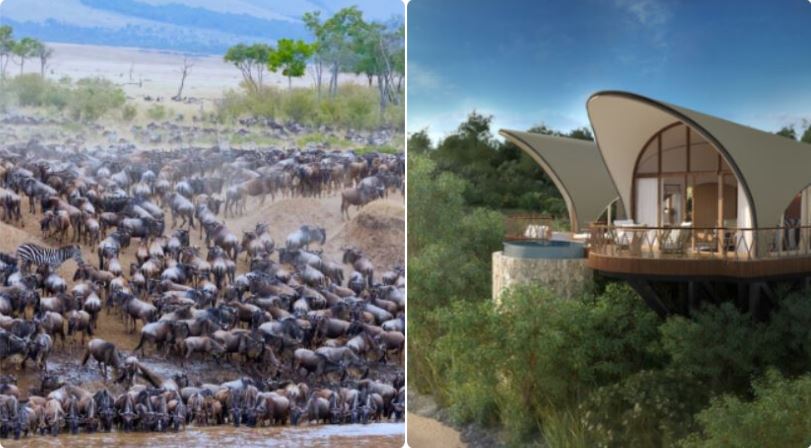
 A coalition of regional and human rights organizations has asked the Environment and Land Court to order a stop to further development of accommodation facilities in the Maasai Mara National Reserve. The groups argue that luxury camps threaten the wildebeest migration corridor.
The petition, filed by the East Africa Law Society, Natural Justice, JustAct and the Africa Centre for Peace and Human Rights, targets Ritz-Carlton Hotel Company LLC, Marriott International Inc, Lazizi Mara Limited, the Narok County Government, the National Environment Management Authority (NEMA), the Attorney General, the Kenya Wildlife Service (KWS), The Safari Collection Ltd., and Minor Hotels Ltd.
The organizations are also seeking conservatory orders to halt the construction or expansion of accommodation facilities within the reserve, particularly in the Low Use Zone and the Mara River Ecological Zone, until the court determines the case.
The groups also asked the court to certify the petition as one of substantial public importance and to refer it to the Chief Justice for the empanelment of a five-judge bench.
In court documents filed by advocate Gichohi Waweru, the petitioners challenged the construction and operation of the Ritz-Carlton Maasai Mara Safari Camp near the Sand River. They argued that the camp developed in a protected ecological zone despite a moratorium on new accommodation facilities in the reserve.
The petitioners said the 20-suite luxury camp, which reportedly charges more than USD 3,500 per night, went up without a valid Environmental Impact Assessment (EIA) license. They also claimed the developers built within areas reserved for environmental conservation under the Maasai Mara National Reserve Management Plan 2023–2032.
They further alleged that Sala’s Camp, operated by The Safari Collection Ltd., and Elewana Sand River Masai Mara, operated by Minor Hotels Ltd., also operate unlawfully within protected zones.
The petition relied on research from the University of Glasgow’s Serengeti Biodiversity Programme, which, the applicants said, analyzed 26 years of GPS tracking data. They claimed the research shows that the Ritz-Carlton camp sits along a critical wildebeest migration corridor.
Also Read – Viral Videos Mislead Public: KWS Says Ritz-Carlton Camp Doesn’t Affect Wildebeest Migration
According to the court documents, the researchers found that the high-density migration route across the Sand River vanished after construction of the camp began in 2022, forcing many wildebeest to remain on the Tanzanian side of the border.
The organizations argued that the annual wildebeest migration constitutes a globally significant ecological phenomenon, protected under international environmental treaties to which Kenya is a party.
The petitioners asked the court to determine whether wildlife migration corridors receive protection under the Constitution, whether Kenya’s international environmental obligations can be enforced directly in local courts, and whether leasing land within a national reserve for commercial tourism requires parliamentary approval.
They also sought orders directing relevant government agencies to conduct an audit of all hotels and accommodation facilities operating within the reserve’s protected zones and to submit the audit report to the court.
The organizations argued that without court intervention, further development could inflict irreversible ecological damage during the current 2026 wildebeest migration season. They said this would threaten one of Kenya’s most iconic wildlife spectacles and a major tourism draw.