A pre-match preview once meant picking the louder crowd or the bigger name. Today, analysts weigh expected goals, pressing sequences, and squad availability before assigning probabilities — and the gap between guesswork and evidence is easier to measure than ever.
Before any fixture, most serious football prediction workflows combine team statistics, recent form, and model outputs rather than relying on reputation alone. That shift does not remove upsets, but it clarifies what data can support before kick-off and what still belongs to chance.
Match Prediction Starts With Team Statistics, Not Gut Feel
Modern match prediction depends on structured team statistics rather than headline records. A club on a four-game winning streak may still underperform its xG, concede too many line-breaking passes, or face an opponent whose pressing map creates problems in transition.
According to FIFA’s Enhanced Football Intelligence framework, advanced models merge event data with player tracking to show where actions occur on the pitch. Metrics such as ball recovery time, line breaks, and team shape explain performance beyond raw possession percentages.
Useful team statistics for pre-match football analysis include:
- Shot quality — location, body part, and defensive pressure on attempts
- Phase control — time spent in possession, out of possession, and set-play phases
- Defensive actions — pressing intensity and recovery speed after turnovers
- Set-piece frequency — corners, free-kick zones, and aerial duel success
Predictions improve when these numbers come from a consistent sample — ideally five to ten recent matches with similar line-ups — rather than a single high-scoring anomaly.
 How Recent Form Shapes Football Analysis Before Kick-Off
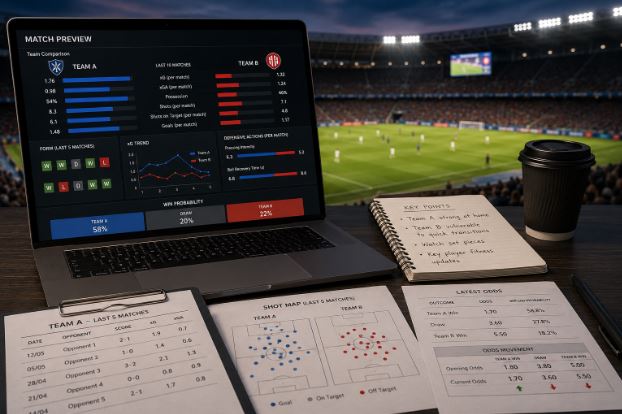 How Recent Form Shapes Football Analysis Before Kick-Off
Recent form matters, but only when defined precisely. Three narrow wins against lower-table sides do not equal three dominant performances against top-half teams. Analysts therefore split form into:
- Results form — points, goals for, goals against
- Process form — xG difference, chance creation, defensive stability
- Context form — home or away, midweek fixtures, travel, rotation
A team resting key players before a cup tie may show weak recent form in points yet strong underlying numbers in football analysis models. Conversely, a side riding a hot streak may regress if its shot map shows low-quality chances and unsustainably high conversion rates.
Before kick-off, recent form should answer practical questions:
- Who is available, injured, or suspended?
- Has the manager changed shape in the last three matches?
- Are results driven by set pieces or open-play dominance?
- Did the last opponent play in a style similar to the next one?
Form without context inflates match prediction confidence. Form with context keeps forecasts honest.
Betting Odds, Models, and What Analytics Cannot See
Betting odds reflect market consensus, not truth. Bookmakers price teams using team statistics, recent form, home advantage, and public sentiment.
When model probabilities diverge from betting odds, analysts look for value — but only after checking whether the gap comes from information the market already absorbed.
Typical pre-kick-off model inputs include:
- Elo or power ratings — long-run team strength
- xG-based forecasts — expected scorelines from chance quality
- Head-to-head context — tactical matchups, not just historical wins
- Market movement — late team news shifting odds before kick-off
At major tournaments, federations supply richer data pipelines. UEFA’s official EURO 2024 technology briefing described how optical tracking, connected ball data, and performance feeds supported technical analysis during matches.
Those same data types increasingly feed pre-match scouting reports at club level.
Still, analytics have hard limits before kick-off:
- Late withdrawals — starting line-ups confirmed only 60–90 minutes before kick-off
- Motivation — dead rubbers, rotation, or must-win pressure
- Tactical surprises — new formations absent from recent datasets
- In-game chaos — red cards, penalties, weather shifts
Betting odds often price these risks faster than public models because markets react to news in real time.
Building a Balanced Pre-Match Read
The most reliable football prediction process blends numbers with football analysis judgment. A practical checklist before kick-off:
- Compare team statistics over the last 5–10 comparable fixtures
- Separate recent form into results and underlying process metrics
- Check betting odds movement after team news
- Identify stylistic clashes — high press vs low block, wide overloads vs compact mid-blocks
- Assign a confidence range, not a single fixed scoreline
A model may give Team A a 58% win probability and Team B a 22% chance with 20% for a draw — useful information, not a guarantee.
Football prediction before kick-off is strongest when team statistics, recent form, and structured football analysis work together. Betting odds add a market lens, but they should complement — not replace — model review. Modern analytics can show which side created better chances or enters with a favourable matchup.
They cannot remove the volatility that makes the sport worth watching — but they turn pre-match debate from opinion into evidence.