Former Deputy President Rigathi Gachagua has brushed aside criticism for attending the Ngemi Cia Ruraya cultural event in Seattle, Washington.
Gachagua, accompanied by his wife Pastor Dorcas Rigathi and PLP leader Martha Karua, defended the event as a special cultural and community celebration.
He addressed the backlash on Sunday, July 20, 2025, saying there was nothing wrong in taking part in a cultural exhibition of pride with members of the Kikuyu diaspora. Critics and govenment insiders had accused him of promoting tribalism during his U.S. visit, but he firmly dismissed those claims, urging Kenyans to see the value in preserving their roots, especially while living abroad.
In a bold response to those questioning his involvement in the event, Gachagua doubled down with a culturally loaded remark.
“Traditionally, as the leader of the community, all women who are of marriage age are my wives. So if I dance with my wives, what is your problem? Go look for your wife and dance with her,” he said.
The Ngemi Cia Ruraya cultural event drew a vibrant crowd with performances from renowned artists like Samidoh and nostalgic Kikuyu hits from the 1960s. Gachagua praised the event for igniting a cultural spark among younger Kenyans living abroad.
He fondly recounted the energy on the dance floor:
“When the song came in, young girls and boys were dancing with Musaimo, with Samidoh, to our songs of the 1960s,” he said, visibly pleased by the cross-generational embrace of Kikuyu culture.
For Gachagua, moments like these reflect a cultural renaissance among Kenyans in the diaspora – something he believes critics are struggling to accept. He suggested that some of the backlash surrounding the event stems from unease with the community’s growing pride and solidarity.
“You know, they thought you people in America did not care about your traditions, your culture…[that] you have forgotten who you are,” he said. “They are so bitter because they have seen we are united.”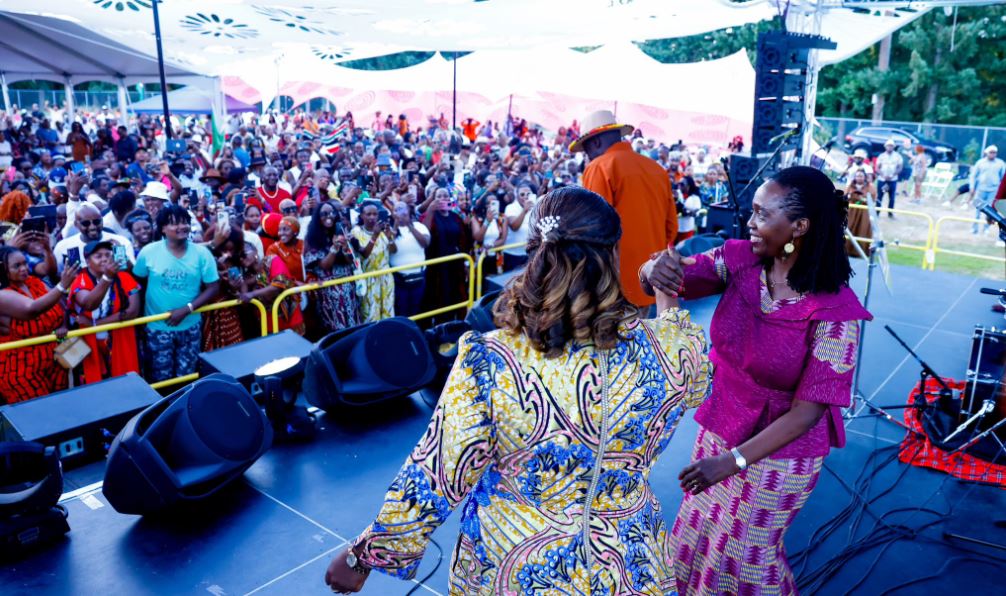
Gachagua Slams Musalia Mudavadi
The former Deputy President was especially dismissive of Prime Cabinet Secretary Musalia Mudavadi, who had accused him of “exporting tribalism” to the U.S. Gachagua didn’t mince words in his response.
“I heard Musalia accusing me of transporting tribalism to America, simply because I am talking to my people. Whom do they want me to talk to? Let him equally come and talk with his people,” he shot back.
He added a local Swahili proverb for good measure: “Pilipili usiyoila yakuwashia nini?” – loosely translated as “Why are you bothered by a chili you didn’t eat?”
Gachagua stood his ground, saying that dancing and celebrating with community members abroad was not only harmless, but necessary for keeping traditions alive.
“If I come to Ngemi Cia Ruraya and I am dancing with my children, I see no problem,” he said.
Gachagua also pointed out the economic power of the Kenyan diaspora. He noted that Kenyans abroad are currently the country’s top earners in foreign exchange, outpacing legacy industries such as tourism, tea, and coffee.
“The current highest foreign exchange comes from diaspora remittances. This underscores the critical role our diaspora community plays in our nation’s economic growth,” he explained.
Gachagua mentioned he had fruitful discussions with Kenyan entrepreneurs based in the U.S. The talks were focused on coming up with pragmatic ways of creating an enabling environment for diaspora investments in Kenya.
“It is clear that we must have serious conversations with our diaspora partners about how to enable them to contribute even more effectively to our country’s progress,” Gachagua said.